
From a purely observational standpoint, watching media outlets fumble all over themselves trying to explain why Gen Z men are becoming Christian is hilarious and a little disturbing. Is it a case of missing the forest for the trees, or is the answer right there in front of them, though they refuse to see it?
Look, it’s really not that difficult, because it’s not a matter of defying the new cultural norms that seem to dynamically change every few years. It’s a matter of men existing in a first-world country, a country opposed to the idea of masculinity. Men cannot be masculine, at least to some degree.
It’s like demanding a bird learn to swim in the deep. Gen Z Christians are growing because it’s what men have to turn to in a society that largely despises them. It’s where they are welcome, and it also allows them to be who they are: men. Imagine that.
Is Gen Z Becoming More Religious?
Gen Z is not becoming more religious as a whole, only in the male demographic. Women are heading in the opposite direction, for reasons we’ll dive into below. Only 46% of Gen Z men describe themselves as “disaffiliated” from religion, versus 54% of women.
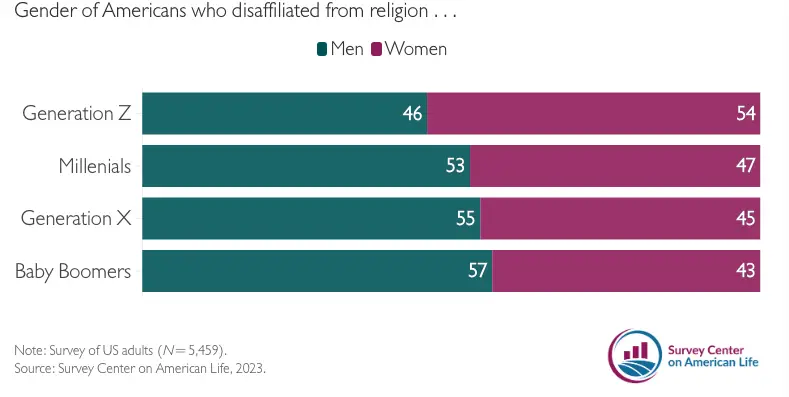
That’s a first throughout all of American history. It’s not a surprise either, when you consider the fact that men and women are heading in opposite directions in almost every meaningful social, cultural, educational, political, and religious statistic.
It’s not a question of whether or not Gen Z is becoming more religious. If anything, Christianity is stabilizing after decades of slow entropy, and Gen Z men are the driving force behind it.
The Truth is in the Details: Why Gen Z Men Are Becoming Christian
Nobody wants to do this, of course, but here’s the challenge: Turn on your TV and watch something that frequently features commercials. Obviously, not every commercial will feature family dynamics or gender comparisons, but pay attention to the ones that do.
The challenge is to find one commercial where the man is presented as a leader, stoic, masculine, smart, and honorable, regardless of whether the advert has a comedic edge or a dramatic one. You’ll spot the pattern pretty quickly.
Men are generally represented as weak, dull, fumbling all over themselves, comedic in their stupidity, and second fiddle to everyone else, especially women. While it’s true that women prefer less masculinity once they are past their most fertile years, less masculinity is not the same as an effeminate weakling.
Unfortunately, women are being taught that men should be more effeminate, and men are being taught to disavow everything that makes them a man, in order to have a proper place in today’s society. That last is the heart and soul of why Gen Z men are becoming more Christian. But there’s still more…
- Boys’ and men’s spaces are fragmented, fading out, or becoming co-ed, while girls’ and women’s spaces are remaining single sex
- 15% of men claim they have no close friends
- 60% of men under the age of 30 claim they are single
- Men have a far greater risk of cardiovascular disease, anxiety, depression, and dementia
- Men are 4x more likely to commit suicide than women
Grievance Rhetoric Isn’t The Driving Factor
At least not in the way it’s portrayed. Gen Z Christian males are often depicted as misogynists, nationalists, and religious zealots. Of course, all of the regular talking heads are getting in on the act, like Vox, Slate, Rolling Stone Magazine, etc., all of which have a long and documented history of having both feet planted firmly on the left side of the political divide.
But Gen Z men aren’t flocking to the church because they hate women and love themselves. They’re flocking to Christianity because they have no meaning in their lives. Every waking moment, from grade school to adulthood, is subordinate to left-wing political ideology, which preaches toxic masculinity and man-hate at every turn.
There’s no solace in relationships, particularly marriage. Women file for divorce at a roughly 70 to 75% rate, and the vast majority of reasons are frivolous (i.e., finding myself, lack of communication, lack of commitment, boredom, not seeing eye-to-eye). These are natural complications in marriages, complications that used to be something worth overcoming.
But, with no-fault divorce and the astonishing level of benefits a woman can gain from divorce, the incentive for her to file is enticing. Men have everything to lose and very little to gain. Companionship is great, but not when measured against financial ruin and children you can barely see.
Derek Rishmawy, Minister at the University of California, summed it up nicely: “Christianity is the one institution that isn’t initially and formally skeptical of them as a class. We’re telling them ‘you are meant to have a meaningful life ‘ at a time when that is not always the primary message they receive from the world around them.”
Women Abandoning Christianity Boosts the Disparity
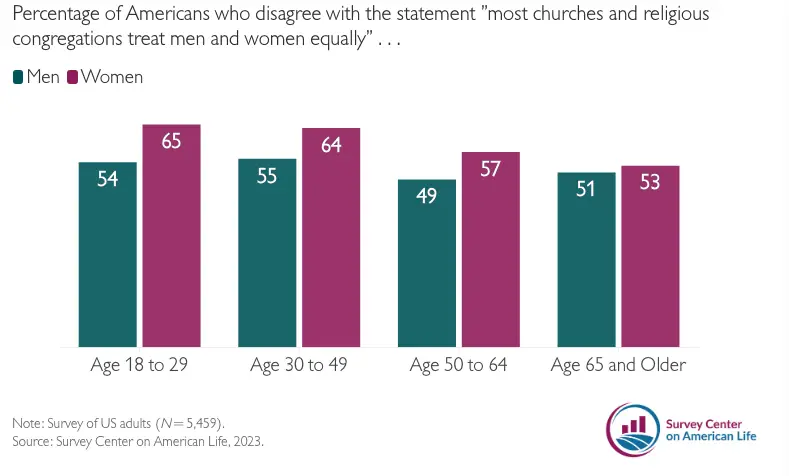
It’s not just a matter of why Gen Z men are becoming Christian. It’s a matter of an active division taking place, with more and more women abandoning the church in favor of careers and hyper-feminized thinking, most of which is perpetuated in institutions of higher learning.
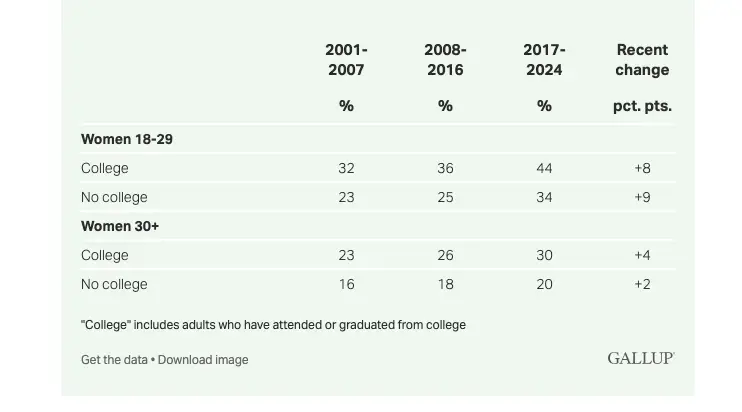
That’s not an opinion, yet it runs counter to the run-of-the-mill research being released today. A deeper dive into that research reveals the key flaws, however. There’s a reason college degrees are becoming more and more worthless by the minute, and it’s not because institutions of higher learning are “teaching,” as the term “indoctrination” originally meant (stems from the Latin docere).
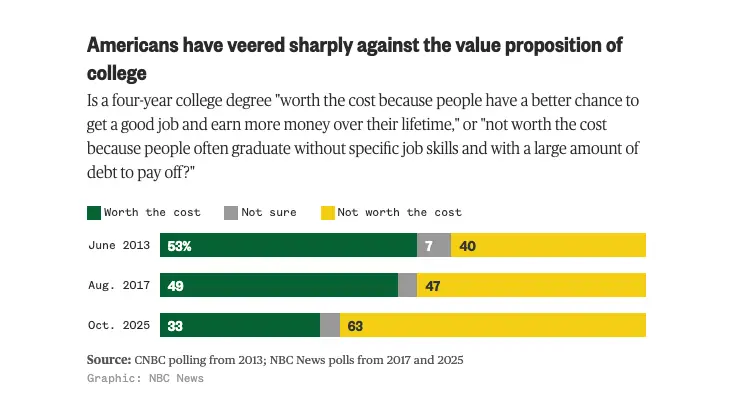
These statistics stem from real-life experience, not from some federally funded research survey leaning on overly innocuous terminologies. Women go to college as conservatives, moderates, and liberals. When they leave, they’re liberals. I taught my kids there are two sides to every story/struggle, and if you find yourself learning a singular viewpoint, you’re being indoctrinated, not learning.
It’s not an “us versus them” claim, merely an observation that the arena of ideas is rapidly becoming an arena of echoing sameness, and men are not welcome, nor are they interested.
Frequently Asked Questions (FAQs)
How does the Christian community give Gen Z men real brotherhood?
The Christian community offers Gen Z men a sense of brotherhood by forefronting traditional, masculine roles, the nuclear family, leadership, and a stoic, Thomistic mindset. Gen Z men rarely find these things anywhere else.
What does this shift mean for dating, marriage, and family?
What this shift means is difficult to foresee, especially considering the sharp divide between women and men attending church or embracing Christianity. Men will obviously lean into leadership and traditional masculine roles, while women will continue trending towards anti-family, anti-men stances antithetical to their nature.
How does social media shape Gen Z masculinity and faith?
Social media shapes men’s masculinity and faith through necessity. While church attendance is up, it’s far from the best way to reach young men. Christian social media influencers have far more reach in a world where everyone and everything is connected to the web in perpetuity. It makes sense that most Gen Z men will have their first brush with philosophical and deeper Christian doctrines and theologies via social media.
Does Christianity offer a healthier model of masculinity?
Yes, Christianity offers a healthier model of masculinity because it sticks closely to natural male instincts and tendencies, replacing society’s nonchalant, often cruel disregard of men and mass-efforts to feminize them with leadership values, a sense of place in the family hierarchy, and meaning when the world offers none.